

Table of Contents
- Why Look for Murder Mystery Party Alternatives?
- Quick Comparison: Top Alternatives at a Glance
- Party Games Like Murder Mystery: Social Deduction and Whodunit Options
- Family-Friendly Mystery Games for All Ages
- Mystery Box Games for Groups: Subscription and Box Set Experiences
- Escape Room Games at Home: Puzzle-Based Alternatives
- How to Choose the Right Alternative for Your Group
- Conclusion: Picking Your Next Mystery Experience
- Frequently Asked Questions
Last Updated: October 7, 2026
Why Look for Murder Mystery Party Alternatives?
A murder mystery party is a hosted game where guests work through clues, suspects, and evidence to identify a killer.
That is why so many hosts now search for the best murder mystery party alternatives.
This guide from Killer Mystery breaks down the alternatives that actually work for game night in 2026: social deduction games, family-friendly whodunits, subscription boxes, box sets, and at-home escape room puzzles.
The best part? Most of these options need nothing more than a table, a few players, and a couple of hours.
Quick Comparison: Top Alternatives at a Glance
The table below sorts the main options by group size, setup effort, and best use case. Use it to narrow your shortlist.
| Alternative | Best For | Group Size | Setup Effort |
|---|---|---|---|
| Subscription mystery box | Ongoing monthly game nights | 1-6 players | Low |
| Complete box set | Binge-solving a full season | 1-6 players | Low |
| Single-story mystery game | One-night date nights | 1-4 players | Low |
| Social deduction party game | Big, loud groups | 5-12 players | Very low |
| Family-friendly whodunit | Mixed-age gatherings | 4-10 players | Low |
| At-home escape room | Puzzle-focused teams | 2-8 players | Medium |
One pattern stands out: the options with the least setup get played the most. Games that demand costumes, printed scripts, and a fixed guest list often sit on a shelf after a single run.
Party Games Like Murder Mystery: Social Deduction and Whodunit Options
Social deduction games are the closest cousins to a murder mystery party.
The format scales to large groups, needs almost no materials, and runs on conversation alone. A single round takes 15 to 30 minutes, so you can play several in one evening.
Where it falls short is story. Social deduction games give you a role and a goal, not a narrative.
Whodunit games sit between the two. They hand out a scenario, a set of suspects, and clues to examine.
What the main formats actually ask of your group
| Format | Typical player count | Round or session length | What players do |
|---|---|---|---|
| Hidden-role social deduction | 5-12 | 15-30 minutes per round | Talk, accuse, vote, bluff |
| Team-vs-team deduction | 4-10 | 30-45 minutes | Share clues, debate, eliminate suspects |
| Structured whodunit | 4-10 | 60-120 minutes | Read a scenario, examine evidence, name a suspect |
| Case-file mystery | 1-6 | 90 minutes to several sessions | Work puzzles, cross-reference documents, build a case |
A few well-known examples show the range. Hidden-role games like Werewolf and The Resistance let accusations fly; Mafia-style games add a narrator. Team deduction games like Deception: Murder in Hong Kong give one player a secret role and the rest a shared evidence board. Structured whodunits like Hunt a Killer and Unsolved Case Files hand you documents, photos, and a suspect list.
How to pick between them
- If your group is large and loud: hidden-role social deduction. It needs no table space and no reading.
- If your group likes evidence: a structured whodunit or case-file mystery. Physical clues keep hands busy and give quiet players a job.
- If your group is small: a case-file mystery built for 1-6 players. Social deduction falls apart below five players because there are not enough suspects to argue about.
- If your group hates lying: skip hidden-role games. The whole format depends on bluffing, and players who refuse to bluff break the game for everyone.
For a group that loves arguing about motives, social deduction is the easy pick. For evidence-driven case building, a structured whodunit works better. And for a story that keeps going after the first night, a multi-episode case-file mystery is the closest thing to a murder mystery party without the costumes. Expanding your repertoire beyond these specific formats reveals a variety of better party options that maintain the same spirit of collaborative investigation and shared discovery.
Family-Friendly Mystery Games for All Ages
Family-friendly mystery games strip out the gore and keep the puzzle, making them a strong fit for households with teenagers, mixed-age gatherings, and anyone who wants a clean, all-ages activity.
The best family options share a few traits:
- A clear suspect list that everyone can follow
- Clues that reward observation, not trivia
- A difficulty level that keeps teens engaged without losing younger players
- No graphic content, so the whole table stays comfortable
A common mistake is assuming family-friendly means easy. The good ones still take real thinking. They just swap shock value for logic puzzles, timelines, and motive analysis.
If you have teenagers looking for something to do together, this category solves the "played once, then forgotten" problem. A multi-episode mystery gives the family a reason to return week after week instead of a single sitting.
Mystery Box Games for Groups: Subscription and Box Set Experiences
Mystery box games for groups deliver a case to your door in pieces.
This is where Killer Mystery does its best work. Our murder mystery subscription box sends one new episode every month for five months, so the case builds instead of resolving in a single night.

Prefer to solve at your own pace? The complete box set ships all five episodes of The '80s Were Killer at once for $129.99. Same structure, no monthly wait.
The subscription model fixes the biggest flaw in one-time mystery games. A box set you finish in one weekend gets shelved. A season that arrives monthly keeps your group guessing for five months.
Escape Room Games at Home: Puzzle-Based Alternatives
Escape room games at home trade the dinner party for a puzzle box. Instead of roleplaying a suspect, your team works through locks, ciphers, and hidden clues against a clock.
Murder Mystery Box Set - Season 1: The '80s Were Killer - Complete Season →
The appeal is focus: no acting, no character sheet, no pressure to perform. Everyone contributes by solving, which suits groups that include people who hate being "on."
The trade-off is narrative. Most escape room kits give you a theme and a puzzle chain, not a cast of suspects. If your group wants to interrogate motives and name a killer, a pure puzzle box will not scratch that itch.
What to expect before you open the box
| Factor | What most kits require |
|---|---|
| Prep time | 20-45 minutes to cut, fold, and sort components |
| Table space | One large table plus room for scattered papers |
| Player count | 2-8, with 3-5 being the sweet spot |
| Session length | 60-90 minutes |
| Reset | Most kits are one-and-done; some allow replay if you do not write on components |
| Cleanup | 10-15 minutes to sort and recycle paper |
Often one person becomes the de facto game master, reading the setup and confirming answers. Decide who that is before guests arrive so the host is not also the referee.
Accessibility and participation notes
Escape room kits are the most accessible alternative for guests who dislike acting, reading aloud, or competition. The work is shared, the clues are visual, and no one has to perform. A few adjustments help:
- Low vision: choose a kit with large print and high-contrast images, or photograph components and zoom in on a tablet.
- Mobility: a single-table setup works for seated players. Avoid kits that require moving between rooms.
- Reading difficulty: assign one reader to narrate clues aloud so no one is stuck decoding dense text.
- Anxiety: skip the timer. The puzzle chain works the same without a countdown.
Virtual and hybrid play
Some escape room kits ship with a digital companion or printable PDF, making them workable over video. One player hosts the physical components and shares the camera; remote players solve from screenshots. Clunkier than in-person play, but it keeps a spread-out group in the same puzzle.
When to choose an escape room kit over a mystery
Pick an escape room kit when your group wants a shared challenge with a clear finish line and no story to track. Pick a case-file mystery when you want the puzzle-solving to feed into a whodunit with suspects, motives, and a final accusation. The two overlap more than most hosts expect, and some groups alternate between them.
For puzzle lovers who also want a story, a case-file mystery bridges the gap. You still get puzzles and physical evidence, but they feed into a whodunit instead of a countdown.
How to Choose the Right Alternative for Your Group
Match the format to your group before you match it to your mood. Three questions do most of the work.
How many players? Social deduction games shine with 5 to 12. Subscription boxes and box sets work best with 1 to 6. Escape room kits usually suit 2 to 8.
How much setup time? If you want zero prep, choose a social deduction game or a ready-to-play mystery box. If your group enjoys assembly, an escape room kit rewards the effort.
What tone? Family-friendly whodunits keep things clean for all ages. True crime fans tend to want a darker, more serious case with real investigative depth.
- Player count fits the format
- Setup time matches your available evening
- Tone suits every guest
- Budget covers the full experience, not just the first night
- Someone is willing to host and read the rules
If you are torn between a one-time purchase and a subscription, ask how often your group actually meets. A digital gift card lets them pick their own case, and there is merchandise for the friend who already owns every box.
Conclusion: Picking Your Next Mystery Experience
The hardest part of game night is not finding a mystery. It is finding one your group will actually finish. Costumes, scripts, and fixed guest lists create friction, and friction leaves games on the shelf.
Killer Mystery built its games around that problem. Our monthly subscription box delivers a new episode every month for five months, so the case keeps building. Our complete box sets ship the full season at once for groups that want to binge.
Start your investigation with Killer Mystery's monthly subscription plans and turn your next game night into a case worth solving.
Frequently Asked Questions
What is the best murder mystery game to play at home?
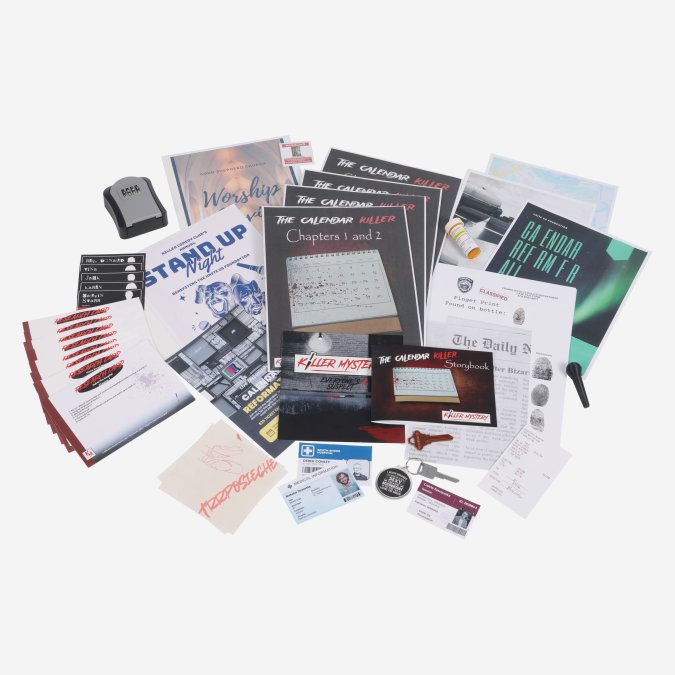
The best at-home murder mystery game depends on your group. For a subscription experience, Killer Mystery's monthly box delivers five episodes over five months, building a season-long case. For a one-time solve, The Calendar Killer is a self-contained story you can finish in one sitting. Both include physical clues, story cards, and puzzles, and work for solo or group play.
How much do murder mystery parties cost?
Costs vary by format. Killer Mystery's single-story game is $39.99, while the complete Season 1 box set is $129.99. The subscription box starts at $29.00 per month for a five-month season, or $129.00 for a season pass. These prices cover all materials, so you avoid the expense of hiring actors or buying separate party supplies.
What are some family-friendly alternatives to murder mystery parties?
Family-friendly mystery games focus on puzzles and deduction without graphic content. Killer Mystery games are designed for ages 14 and up and include no explicit material, making them suitable for family game nights. Other options include escape room games at home and social deduction games that rely on logic rather than mature themes.
How do you choose a party game for a group?
Consider group size, time available, and tone. For 2-6 players who want a structured narrative, a mystery box game works well. Larger groups may prefer social deduction games that accommodate more people. If you have 90 minutes, a single-story game fits; for ongoing fun, a subscription box spreads the experience over months.
What can you play instead of a murder mystery dinner?
You can host an at-home escape room, a social deduction game night, or a mystery box game session. Escape room games at home use puzzles and locks, while mystery box games like Killer Mystery provide physical clues and story cards. Both offer interactive group play without the planning required for a full dinner party.
Comments