

Last Updated: October 30, 2026
Quick Summary
To organize a mystery game tournament, pick a theme and bracket format, build a round-by-round timeline, and write a modular script with one locked solution. Set transparent scoring before Round 1, keep core evidence identical for every team, and plan a tie-breaker in advance.
- Choose solo, team, or head-to-head brackets based on player count and competitiveness.
- Run three rounds with a 10-minute welcome, 10-minute breaks, and a 10-minute reveal.
- Score 10 points for the culprit, 5 for motive, 5 for method, and 3 bonus for speed.
- Cap fastest-submission bonuses at 20% of a round's total points.
- Assign a non-playing host to run rounds, hand out clues, and keep score.
Table of Contents
- Pick a Theme and Format for Your Mystery Game Tournament
- Build a Murder Mystery Party Timeline That Keeps Rounds on Track
- Write a Murder Mystery Party Script That Works for Multiple Teams
- Design Murder Mystery Game Clues and Evidence for Fair Play
- Set Up Scoring, Rounds, and a Tie-Breaker System
- Run Murder Mystery Party Games for Groups Without Chaos
- Choose Your Killer Mystery Kit and Start Your Tournament
- Frequently Asked Questions
Pick a Theme and Format for Your Mystery Game Tournament
A mystery game tournament is a structured event where multiple players or teams compete across several rounds of mystery-solving, earning points for correct deductions and fast thinking. At Killer Mystery, we build our games around exactly this kind of play, and the tournament format is where most hosts either win the room or lose it.
Pick your theme first, then your format. The theme sets the mood and the guest list. The format sets the pace.
Start with the theme. A murder mystery party lives or dies on its premise, so choose one that fits your crowd:
- True crime style: gritty, modern, evidence-heavy
- Decade throwback: 1980s glamour, 1920s speakeasy, 1970s noir
- Locked-room puzzle: one location, one crime scene, tight clues
- Family-friendly: lighter stakes, more teamwork, teen-safe roles
Solo, Team, or Head-to-Head: Choosing the Bracket
Choose your bracket based on how many players you have and how competitive they are. Three formats cover almost every group:
| Format | Best For | Round Style | Scoring Feel |
|---|---|---|---|
| Solo | 4-8 players | Everyone solves alone | Individual leaderboard |
| Team | 8-20 players | Small squads of 3-5 | Team totals |
| Head-to-head | 6-12 players | Two squads face off | Winner-takes-all |
Teams work best for office events and family nights. For a proven team-building format, see the best office murder mystery game for your next team building event. Head-to-head adds real tension.
Build a Murder Mystery Party Timeline That Keeps Rounds on Track
A murder mystery party timeline is the schedule that keeps each round moving, from welcome to reveal. Without one, rounds stretch, players lose focus, and the whole tournament drags.
Here is a simple timeline that works for most groups:
- Welcome and rules (10 minutes): hand out character roles, explain scoring
- Round 1 (25-30 minutes): read the premise, review first clues
- Break (10 minutes): snacks, stretch, compare notes
- Round 2 (25-30 minutes): new evidence, new suspects
- Final round (20 minutes): submit accusations
- Reveal (10 minutes): announce the culprit and the winner
Build in a buffer. For a full walkthrough of hosting duties, read how to host a murder mystery party step by step. Rounds always run long when players are engaged, and that is a good sign.
Write a Murder Mystery Party Script That Works for Multiple Teams
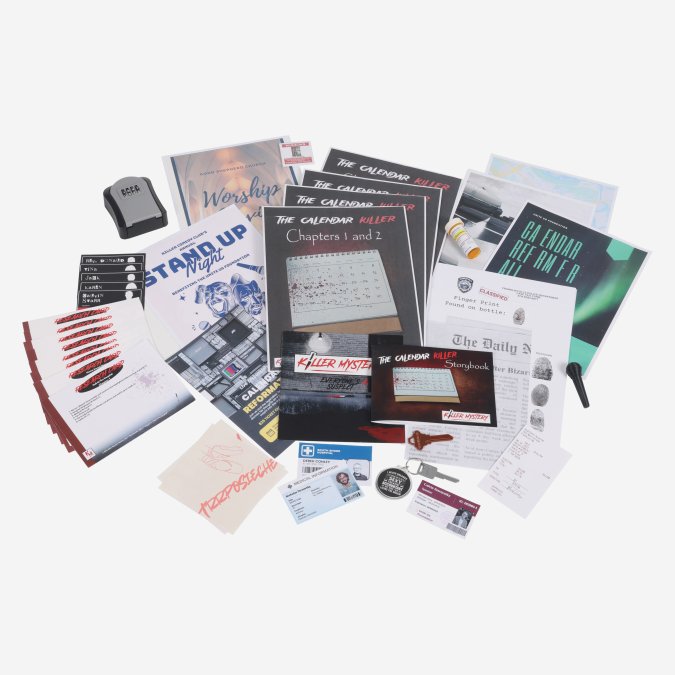
A murder mystery party script is the written framework of characters, clues, and dialogue that guides players through the story. For a tournament, the script has to work for several teams at once, not just one table. Ensuring that every participant has access to the necessary components requires careful preparation of the specific cards required for tournament play.
Keep the script modular. That means:
- Shared opening: every team gets the same premise and crime scene
- Branching clues: each team receives evidence in a slightly different order
- Common characters: the same cast of suspects appears for everyone
- Locked solution: one culprit, so scoring stays fair
Write character profiles in plain language. Each player needs a name, a role, a motive, and one secret. Do not overload roles with backstory. A tight one-page profile keeps the pace up and the confusion down.
The script should also spell out the game rules clearly at the top. Players who understand the mechanics solve faster and argue less.
Design Murder Mystery Game Clues and Evidence for Fair Play
Murder mystery game clues are the physical and written pieces of evidence players examine to name the culprit. Fair clues make a tournament fun. Unfair clues make it frustrating.
Follow these rules for fair evidence:
- Every clue points somewhere. No red herrings that lead nowhere.
- The solution is deducible. A sharp player can solve it from the evidence alone.
- Spread the clues. Do not hide the key clue in one team's packet.
- Mix formats. Physical evidence, research cards, and puzzles together.
Balance matters most. If one team gets a stronger clue set, the leaderboard is meaningless. Give every team the same core evidence and vary only the order.
A good clue reveals a motive, a secret, or a timeline gap. Layer suspects so that each one looks guilty until the evidence clears them. That slow narrowing is the heart of any whodunit.
Set Up Scoring, Rounds, and a Tie-Breaker System
Scoring is what turns a party into a tournament. Set it up before the first round and post it where everyone can see. The goal is a system simple enough to explain in two minutes but precise enough that no one argues about the winner.
The Core Points System
Use a simple, transparent scale:
The Calendar Killer - Premium Single Story Murder Mystery Game →
- Correct culprit named: 10 points
- Correct motive: 5 points
- Correct method: 5 points
- Fastest correct submission: 3 bonus points
Run three rounds, then tally. To schedule each round accurately, check how long mystery games take. Keep a visible leaderboard so teams can track the race. If you want to weight later rounds more heavily, common in tournament play, multiply Round 2 points by 1.5 and Round 3 by 2. Announce the weighting before Round 1 so no one feels ambushed.
Keeping Scoring Fair Across Teams
Fairness breaks down when teams get different clue sets or play at different speeds. Three habits prevent that:
- Same core evidence for every team. Vary only the order clues arrive, never the content.
- Score submissions, not speed alone. A team that solves correctly in 28 minutes should beat a team that guesses in 10.
- Cap bonus points. Fastest-submission bonuses should never exceed 20% of a round's total points, or speed dominates deduction.
If a team finishes early, give them a short side puzzle worth 2 points rather than letting them watch, idle teams disrupt the room.
Tie-Breakers That Actually Work
Plan your tie-breaker in advance and write it on the scoreboard. A sudden-death question about a detail from the evidence settles it fast and fair. Good tie-breaker questions ask about something every team saw but few remembered, a suspect's alibi time, a prop's location, a name on a document.
For three-way ties, run a quick lightning round: three questions, first team to buzz in with a correct answer wins. If you expect frequent ties, add a tie-breaker column to your scoreboard from the start, total clues correctly identified, so you rarely need the sudden-death round at all.
Run Murder Mystery Party Games for Groups Without Chaos
Murder mystery party games for groups fall apart for one reason: no one is in charge of the clock. Assign a host or facilitator who does not play. That person runs the rounds, hands out clues, and keeps score.
A few habits keep a big group calm:
- Announce each round out loud. "Round 2 starts now. You have 25 minutes."
- Hand out clues on a schedule. Do not let teams rush ahead.
- Keep teams separated. Quiet corners, separate tables, no eavesdropping.
- Have a rules referee. One person settles disputes.
Watch out: letting teams share evidence freely turns a tournament into a group solve. Keep packets private until the final reveal.
For hybrid groups, run the same rounds over video and email clue packets as PDFs. The structure stays identical, so scoring remains fair.
Choose Your Killer Mystery Kit and Start Your Tournament
The fastest way to run a smooth mystery game tournament is to start with a kit built for it. Killer Mystery designs every game as a complete, self-contained case, so you skip the scriptwriting and clue design entirely.
Here is how our games map to tournament play:
- The Calendar Killer ($39.99): a single-story game, perfect as a warm-up round or a solo bracket. the board game and puzzle market continues to grow as a social activity
- The '80s Were Killer box set ($129.99): all five episodes in one box, ideal for a multi-round team tournament.
- Monthly subscription box ($29.00): a new episode each month, great for a recurring game night league.
Every kit includes story cards, research cards, physical clues, and puzzles. Play solo or with friends and family, no prior experience needed. Our customers praise the storytelling. Corinne D. left a five-star review saying the games keep you guessing.
Best for: hosts who want a ready-made tournament without writing their own script. Skip if: you prefer to build a fully custom case from scratch.
Ready to run your first bracket? Browse the full range of mystery games and box sets and pick the case that fits your group.
Frequently Asked Questions
How many people do you need for a murder mystery game tournament?
Most mystery game tournaments work best with 6 to 12 players, split into teams of 2 to 4. Smaller groups can run a solo bracket with individual players, while larger groups can rotate teams through multiple rounds. Killer Mystery box sets support solo or small-group play.
How long should a mystery game tournament last?
Plan for 2 to 3 hours total, including setup, 3 to 5 rounds of 20 to 30 minutes each, and a short scoring break between rounds. A murder mystery party timeline that blocks 15 minutes for introductions and 10 minutes for the final reveal keeps the event from dragging.
How do you score a murder mystery tournament?
Award points for correct culprit identification, quality of evidence presented, and bonus puzzle solves. For example, 10 points for the right suspect, 5 points for each clue correctly linked, and 3 points for a completed puzzle. Keep a visible leaderboard and use a sudden-death clue round as a tie-breaker. Document the scoring rules before the first round so every team plays by the same system.
What supplies do you need for a murder mystery party tournament?
You need a game kit with scripts, character cards, clues, and puzzles, plus a timer, a scoreboard, pens, and printed team rosters. For atmosphere, add costumes and decorations tied to your theme. Killer Mystery box sets include story cards, research cards, physical clues, and puzzles in one box.
Organizing a mystery game tournament takes planning, but the payoff is a room full of people arguing over clues and loving every minute. Killer Mystery makes that easy with complete kits, physical evidence, and stories that hold up across multiple rounds. Start with a single-story game or go all in on a full season box set, then set your scoring and let the deductions fly. Get started with Killer Mystery and turn your next game night into a tournament worth talking about.

Comments