

Table of Contents
- Quick Comparison: Best Murder Mystery Games for Groups
- How to Host Murder Mystery Night: A Step-by-Step Guide
- 1. The Calendar Killer: Best for First-Time Hosts
- 2. Subscription Box: Best for Ongoing Game Nights
- 3. Complete Box Sets: Best for Binge-Worthy Parties
- Murder Mystery Game Duration: What to Expect
- Murder Mystery Party Script for Large Groups
- Virtual and Remote Hosting Logistics
- Frequently Asked Questions
Last Updated: September 16, 2026
Quick Comparison: Best Murder Mystery Games for Groups
A murder mystery game for groups turns an ordinary evening into a shared investigation. This guide from Killer Mystery covers what to buy, how to host, and how to keep a room full of suspects engaged.
| Game | Format | Best For | Price |
|---|---|---|---|
| The Calendar Killer | Single story, one box | First-time hosts | $39.99 |
| Subscription Box | 5 monthly episodes | Ongoing game nights | $29.00/month |
| Season Box Sets | 5 episodes in one shipment | Binge-worthy parties | $129.99 |
| Season Pass | Full season, billed once | Dedicated solvers | $129.00 |
How to Host Murder Mystery Night: A Step-by-Step Guide
Hosting well comes down to preparation, pacing, and one firm rule: nobody reads ahead. Set a start time, assign roles in advance, and let the case file do the work.

The Two-Week Planning Timeline
Work backward from the party date with this schedule:
- 14 days out: Lock the date, confirm headcount, and order the game, the last safe window for shipping to remote players.
- 10 days out: Send invitations with character assignments, early enough to plan a costume but not memorize the script.
- 7 days out: Read the host guide cover to cover. Note clue release points, round count, and character secrets that depend on others.
- 3 days out: Prep materials and test puzzles yourself so you can nudge stuck players without spoiling the answer.
- 1 day out: Set the scene, dim the lights, queue the playlist, stage props, confirm food and drink.
- Day of: Arrive early, do a final materials check, and greet guests in character.
Choosing the Right Game for Your Crowd
Match the theme and difficulty to your guests, not your own taste. Ask before you buy:
- How many players? Most kits scale to a small group, but some are written for a fixed cast. Check the player range.
- How much roleplay do they want? Some groups love accents and costumes; others want to solve a puzzle over pizza.
- How long can they stay engaged? A single-sitting case suits a weeknight; a five-episode arc suits a monthly game night.
- Any content sensitivities? Supernatural themes, violence levels, and period settings vary. Skim the story summary before assigning roles.
Invitations and Character Assignments
A simple invitation format that works:
You are invited to a murder mystery party on [date] at [time]. You'll be playing [character name], [one-line description]. Dress as [costume suggestion] if you'd like. Bring your suspicions.
Setting the Scene and Atmosphere
Atmosphere is cheap to create and expensive to skip. Dim the main lights, swap in lamps or candles, and queue a period-appropriate playlist before guests arrive. A single prop, a fake case file, a sealed envelope marked "evidence", gives people something to react to. Costumes don't need to be elaborate: a scarf, a hat, or a name tag is enough to push someone into role.
Running the Investigation in Rounds
Structure the night in rounds to keep pacing tight:
- Welcome and rules (10 minutes). Hand out booklets at the door, not in advance, guests who read their full role early rehearse instead of react.
- Round one: introductions (15-20 minutes). Each player introduces their character in one or two sentences.
- Round two: first evidence drop (20-30 minutes). Release the first clues. Let players discuss, accuse, and form alliances.
- Round three: deeper clues (20-30 minutes). Introduce the next layer of evidence. Contradictions surface and deduction begins.
- Final round: accusation (10-15 minutes). Everyone names a suspect and gives their reasoning. Then reveal the truth.
Build in a food pause between rounds two and three. A break resets momentum and lets quieter players compare notes one-on-one.
Budgeting the Night
The game itself is the smallest line item for most hosts:
- Game kit: the main cost, and the one that determines how much prep you do.
- Food and drink: often the largest expense. A potluck or themed appetizer spread keeps this manageable.
- Props and decor: candles, a playlist, and one or two thrift-store props are usually enough.
- Printing: budget for color printing and cardstock if your kit uses printables.
1. The Calendar Killer: Best for First-Time Hosts
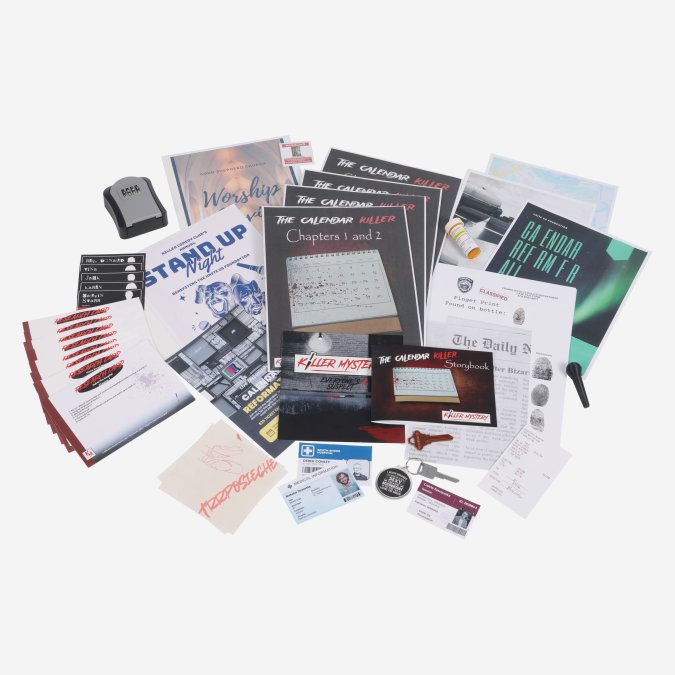
If you're hosting your first murder mystery game for groups, start here. The Calendar Killer is a complete single-story experience with no subscription, buy once and play the whole case in one evening. Calvin Starzynsky wants to rewrite the calendar, and everyone connected to his theories keeps turning up dead. Your group follows the evidence, builds a case, and names the killer.
2. Subscription Box: Best for Ongoing Game Nights
For groups that want a standing monthly ritual, the subscription box delivers one new detective episode each month across a five-month season. Each episode builds on the last, introducing new suspects and fresh evidence until the case closes.
The Calendar Killer - Premium Single →

3. Complete Box Sets: Best for Binge-Worthy Parties
Box sets ship all five episodes of a season together, so your group controls the pace. Killer Mystery's catalog covers many tones: The '80s Were Killer digs into family secrets and corruption around the Hansen fashion empire, Spaced Out follows the death of a would-be astronaut days before launch, The Silent Stones trades in a rural cult and a monolith, Death Beyond The Grave leans supernatural, and Murder At Winter Cabin opens with a blood-soaked floor and a vanished body.

Murder Mystery Game Duration: What to Expect
A single murder mystery game session typically runs 60 to 120 minutes, depending on player count and discussion between clue releases. The Calendar Killer plays through in one sitting, ideal for a single evening.
Murder Mystery Party Script for Large Groups
Large-group mysteries work best when you assign roles in pairs or small teams rather than one character per person, keeping every guest involved even when your headcount exceeds the number of suspects. The script doesn't change; the casting does.
How to Split Roles When You Have More Guests Than Characters
Most kits are written for a fixed cast, often six to twelve suspects. If your guest list runs larger, you have three workable options:
- Team casting: Assign two or three guests to each character. They share the booklet, decide together how to play the role, and speak with one voice during accusations. Works well for couples or friend pairs.
- Investigator roles: Keep the core cast as written, then add non-suspect roles for the overflow. Investigators get a subset of the evidence, can question any suspect, and vote on the final accusation.
- Forensic and press roles: A forensic analyst who reveals physical evidence, or a reporter who interviews suspects between rounds, gives extra guests a clear job and a reason to talk.
Structuring Investigation Teams
For a big room, split the group into investigation teams and give each team a subset of the evidence. Teams compare notes mid-game, which creates natural conversation and prevents quieter guests from getting steamrolled by the loudest voice.
- Three to four teams of three to five players each. Smaller teams give everyone a chance to speak.
- Each team gets a different evidence packet. One team gets the timeline, another the financial records, a third witness statements. No team has the full picture.
- Mid-game cross-examination. After round two, teams send one representative to another team to trade information.
- Team accusation. At the end, each team names a suspect and presents its case. The team whose reasoning holds up wins, even if they named the wrong person.
Pacing a Large Room
A room of twenty moves slower than a table of six. Adjust accordingly:
- Set a hard cutoff for each discussion round. Use a visible timer. When time's up, move on, even if the debate is lively.
- Assign a game master whose only job is timing and clue release. In large groups, this role matters more than the script, someone has to keep the clock moving and decide when the next clue drops.
- Designate one person to track accusations on a whiteboard. A visible suspect board keeps everyone oriented and gives quiet players something to study.
- Use a microphone or designated speaker for announcements. In a big room, half the guests won't hear a normal voice over the chatter.
Practical Adjustments for Larger Parties
- Print extra copies of the character booklets so teams can each hold one.
- Seat teams at separate tables if space allows; it cuts cross-talk and makes team huddles feel intentional.
- Put food and drinks in a separate area so people don't graze through the deduction.
- Brief your game master in advance on the clue schedule and the answer, so they can nudge without spoiling.
Virtual and Remote Hosting Logistics
Remote hosting works, but it needs a different setup than an in-person party.
Frequently Asked Questions
How long does a typical murder mystery game last?
Most murder mystery games for groups run between 60 and 120 minutes per session. Single-story games like The Calendar Killer are designed to be solved in one sitting, while box sets with five episodes can be spread across multiple game nights. Each episode in a season builds on the last, so you can play at your own pace without feeling rushed. The duration depends on how deeply your group examines the evidence and discusses suspects.
Can you play murder mystery games virtually with a group?
Yes. Virtual hosting works well for murder mystery games when you share digital versions of the story cards and clues on screen. Assign one person as the game master to guide the investigation and reveal evidence at the right moments. Physical clues can be described aloud or mailed to players in advance. Video calls keep everyone engaged, and breakout rooms let smaller teams discuss theories privately before rejoining the group to share findings.
Do you need costumes for a murder mystery party?
Costumes are optional but they add to the immersive experience. A 1920s theme might call for flapper dresses and fedoras, while a winter cabin mystery suits cozy sweaters and scarves. You can suggest a simple dress code rather than requiring full costumes. The focus stays on solving the case, so even a single accessory like a magnifying glass or a detective's notebook helps set the mood without pressure.
What is a good murder mystery game for beginners?
The Calendar Killer is a solid starting point because it is a complete single-story game with no subscription required. It includes a welcome booklet, story cards, research cards, physical clues, and puzzles, so new players get guided investigation prompts at every step. No prior experience is needed. Once your group finishes, you can move on to a five-episode box set or a monthly subscription for longer story arcs.
How do you host a murder mystery party for a large group?
For large groups, divide players into small investigative teams of three to five people. Each team reviews the same evidence but discusses theories separately before sharing conclusions with the full group. Use a murder mystery party script for large groups to keep the investigation on track and ensure every team gets equal time to present their suspect. A dedicated game master manages clue distribution and keeps the pace steady.
Comments