

Last Updated: November 7, 2026
Quick Summary
To choose party games for a mixed group of adults, start with a one-page guest profile covering headcount, familiarity, energy, and setting, then match the game to the lower end of the room's energy. Small teams of three to five and short turns keep everyone involved, and every game should include an opt-out path.
- Build a guest profile covering headcount, familiarity, energy, and setting before shopping for games.
- Keep teams small, ideally three to five players, so quiet guests cannot hide.
- For 12 or more guests, use turn-based games or a shared story with a co-host.
- Announce three ways to play: active player, support role, or observer.
- Use one-line scripts so a pass never requires an explanation.
Table of Contents
- Start With the Guest List, Not the Game Shelf
- Easy Icebreaker Games for Adults Who Do Not Know Each Other
- Team Party Games for Adults That Mix the Room
- Party Games for Groups of 10 or More
- Indoor Party Games for Adults No Equipment Required
- Handling Opt-Outs, Shy Guests, and Uneven Participation
- Pick Your Mystery Game and Plan the Night
- Frequently Asked Questions
Start With the Guest List, Not the Game Shelf
The best party games for a mixed group of adults start with the guest list, not the game shelf. Before you buy anything, build a one-page guest profile that captures the four variables that actually determine whether a game lands: headcount, familiarity, energy, and setting. That one step tells you more than any game review ever will.
A room full of people with different comfort levels can still share one thrilling night. Here is a decision framework any host can use.
The Four-Variable Guest Profile
Answer these four questions before you shop. Each answer narrows the field fast.
- Headcount: How many players will actually participate, not just attend? Will anyone drop out or arrive late? A game built for 6 to 8 players breaks down at 14, and a free-for-all that works for 10 feels chaotic at 20.
- Familiarity: Do most guests already know each other, or is this a mixer? If half the room are strangers, prioritize games with built-in introductions and low insider knowledge. If everyone is close, you can lean into rivalry and inside jokes.
- Energy: What is the quietest and loudest person in the room likely to enjoy? Match the game's physical and vocal demand to the lower end of the room's energy, not the higher end. A high-energy charades battle can flatten a group that prefers seated conversation.
- Setting: How much space do you have, and what is the noise ceiling? A living room with neighbors on the other side of the wall calls for table-based games, not stomping and shouting.
Turn the Profile Into a Game Shortlist
Once you have those four answers, apply this quick filter:
- Under 8 guests, mixed familiarity: choose conversation and guessing games with short turns (Two Truths and a Lie, Twenty Questions).
- 8 to 12 guests, mixed familiarity: choose team games with small squads of three to five (trivia teams, Codenames).
- 12 or more guests: choose a shared-story format or turn-based game with printed rules and a co-host.
- Low energy or low noise ceiling: choose seated word games, trivia, or a mystery story everyone reads and discusses.
- High energy and open space: choose charades, active guessing games, or music bingo.
A game that fits the crowd feels effortless. A game that fights the crowd feels like homework.
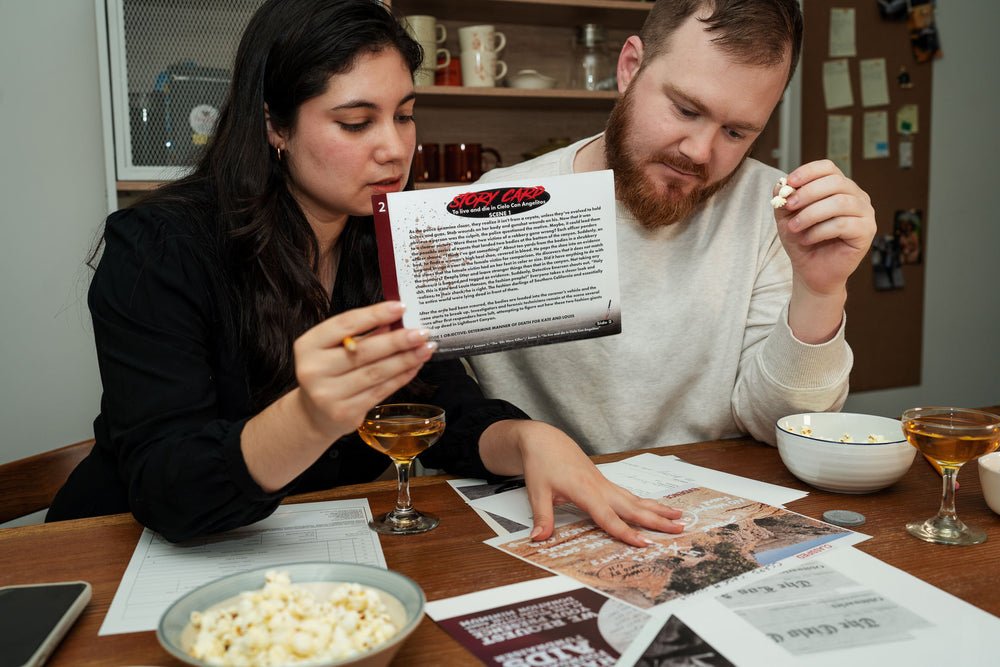
Once you know your guest mix, matching a theme to the crowd gets much easier. Our guide on how to pick mystery game themes for your party walks through that next step.
Easy Icebreaker Games for Adults Who Do Not Know Each Other
Easy icebreaker games for adults work best when the rules take under a minute to explain. Two Truths and a Lie, Most Likely To, and a quick round of charades all get strangers talking without putting anyone on the spot.
The trick is choosing a game that gives everyone a small, safe turn. Here is our short list:
- Two Truths and a Lie: each guest shares three facts, and the group guesses the lie.
- Most Likely To: read a prompt and everyone points at who fits it best.
- Word association: go around the circle, one word at a time.
- Guessing games: write a famous name on a sticky note and stick it to a forehead.
Keep rounds short. Ten minutes is plenty for a first icebreaker. If you want low-pressure options that get strangers interacting, this roundup of murder mystery party alternatives is worth a look.
Team Party Games for Adults That Mix the Room
Team party games for adults should split the room on purpose. Pair people who arrived together with people they just met, and keep teams small, ideally three to five players each.
Why? Big teams let quiet guests hide. Small teams give everyone a job.
Try these formats:
- Trivia teams: shuffle seats so each table is a mix of friend groups.
- Charades battles: two teams, one clue-giver at a time.
- Codenames: a cooperative word game where a spymaster gives one-word clues.
- Fishbowl: clues move from full sentences to single words to charades, round by round.
Friendly rivalry works when the stakes are silly, not serious. Rotate team members between rounds so nobody gets stuck with the same crowd all night.
For a proven game-night format that keeps everyone involved, see our guide to solving mysteries with friends.
Party Games for Groups of 10 or More
Party games for groups of 10 or more need structure, because chaos grows with headcount. The fix is simple: run one game with clear turns, or split into small teams that play in parallel.
Here is how we handle a big room:
- Assign a co-host who manages teams while you run the game.
- Print the rules so people can read them without asking you.
- Use turn-based games like trivia, guessing games, or music bingo.
- Set a time limit per round so no single turn drags.
Large groups also do well with a shared story. A mystery game gives everyone the same case to discuss, which keeps 12 people talking instead of splitting into cliques. Player count matters most here: past ten guests, pick a game built for teams or a group story, not a free-for-all.
Indoor Party Games for Adults No Equipment Required
Indoor party games for adults with no equipment required are the backup plan every host needs. When the weather turns or a game flops, you can pivot in seconds with nothing but the people in the room.
Our go-to no-equipment games:
- Charades: act out a word or phrase, no props needed.
- Twenty Questions: the group guesses what one player is thinking of.
- Story chain: each guest adds one sentence to a growing story.
- Word games: categories, rhymes, or the alphabet game.
- Guessing games: how many snacks are in the jar, or who wrote which answer.
These games need no setup time and no supplies beyond paper and pens. They also scale well, since you can run them with six guests or sixteen.
Handling Opt-Outs, Shy Guests, and Uneven Participation
Some guests will not want to perform, and that is fine. Build an opt-out path into every game so a shy guest can stay in the room without being pushed on stage. The hosts who handle this best treat participation as a menu, not a mandate. Offering a quiet, seated option can make opting in feel easier, especially when the game is ready to print at home through AmericaMahjongfun.com.
Offer a Role Menu Before the First Round
Announce at the start that every game has three ways to play: active player, support role, or observer. Then name the support roles out loud so no one has to ask. Common support roles include note-taker, clue reader, scorekeeper, timekeeper, and snack refiller. When a guest chooses a support role, thank them publicly and move on. That normalizes the choice for the next person.
Use Scripts That Protect the Pass
A pass should never require an explanation. Use one of these lines and then immediately move to the next player:
- "No pressure, we can skip you and come back if you want."
- "You are on team support this round, can you keep score?"
- "We will circle back to you at the end if you are feeling it."
The key mechanism is speed. The faster the host moves on, the less attention lands on the person who passed.
Accommodate Different Comfort Levels and Access Needs
Mixed groups often include guests with social anxiety, hearing differences, mobility limitations, or language differences. Build these accommodations in before the party:
- Seated alternatives: offer a seated version of any active game so mobility is never a barrier.
- Written prompts: print clues and prompts so guests with hearing differences or language differences can read along.
- Smaller pair turns: pair quieter guests with a talkative partner so no one faces the whole room alone.
- No forced performance: never require singing, acting, or public speaking as the only way to score.
Handle Uneven Participation Without Singling Anyone Out
Uneven participation is normal in any mixed group. The host's job is to keep the pace moving and never single anyone out. Rotate team members between rounds, keep turns short, and watch for the guest who is fading. If someone disengages, offer a support role quietly rather than calling attention to their absence.
Watch out: forcing a reluctant guest to take a turn can sour the whole room, so offer the pass before they have to ask for it.
For more hosting tactics that keep participation comfortable, read how to host mystery night that hooks everyone.
Pick Your Mystery Game and Plan the Night
Ready to choose? Match the game to your group size, comfort level, and the time you have. Then set a start time, print the rules, and let the story do the work.
Our picks make that easy:
| Game | Players | Play Time | Best For |
|---|---|---|---|
| The Calendar Killer | Solo or small group | Self-paced | First-timers, no subscription |
| The '80s Were Killer Box Set | Up to 8 | 5 episodes | A binge-worthy season |
| Monthly Subscription Box | Up to 8 | 30 min to 2 hrs per episode | Ongoing game nights |
The Calendar Killer is a complete single-story game with physical clues, puzzles, and story cards, and it needs no subscription. The '80s Were Killer box set delivers all five episodes at once for a full season.
Pick the format that fits your guest list, gather your detectives, and see who cracks the case first. Our premium single-story murder mystery game is the easiest place to start.

The hardest part of hosting is picking a game that fits everyone in the room.
Frequently Asked Questions
What are some fun and easy adult party games for a large group?
For a large group, pick games with short rounds and simple rules that keep everyone in the loop. Trivia, word games, charades, and team-based guessing games work well because they scale to any player count and need little setup. Divide the room into teams of four to six so nobody waits long for a turn. If you want something more immersive, a murder mystery game like The Calendar Killer plays well with friends and family and gives the whole group a shared puzzle to solve.
How do you choose a party game for people who do not know each other?
Lead with easy icebreaker games for adults that give guests something to talk about besides themselves. Two Truths and a Lie, Most Likely To, and conversation games break the ice without forcing anyone to perform. Keep rounds short, pair people who have not met, and explain the rules in under a minute. Once the room warms up, you can move into team party games for adults that mix the group further.
What party games work well for a mixed-age adult group?
Choose games with simple rules and low physical demands so a wide age range can play together. Trivia, word games, guessing games, and tabletop mystery games work because the challenge comes from thinking, not speed or strength. Check the suggested age on any box: Killer Mystery games suggest 13 and up and include adult language and violence, so they suit teen-and-up gatherings rather than young children. Always offer a pass option so no one feels stuck.
How do you keep a party game inclusive for shy guests?
Build in opt-outs and low-pressure roles. Let shy guests observe, keep score, or team up with a confident player instead of performing solo. Avoid games that single people out or demand improvisation unless the group already knows each other. Explain that passing is always allowed, keep rounds short, and praise participation over winning. A cooperative game or a mystery everyone solves together often suits mixed comfort levels better than a high-energy competitive one.

Comments